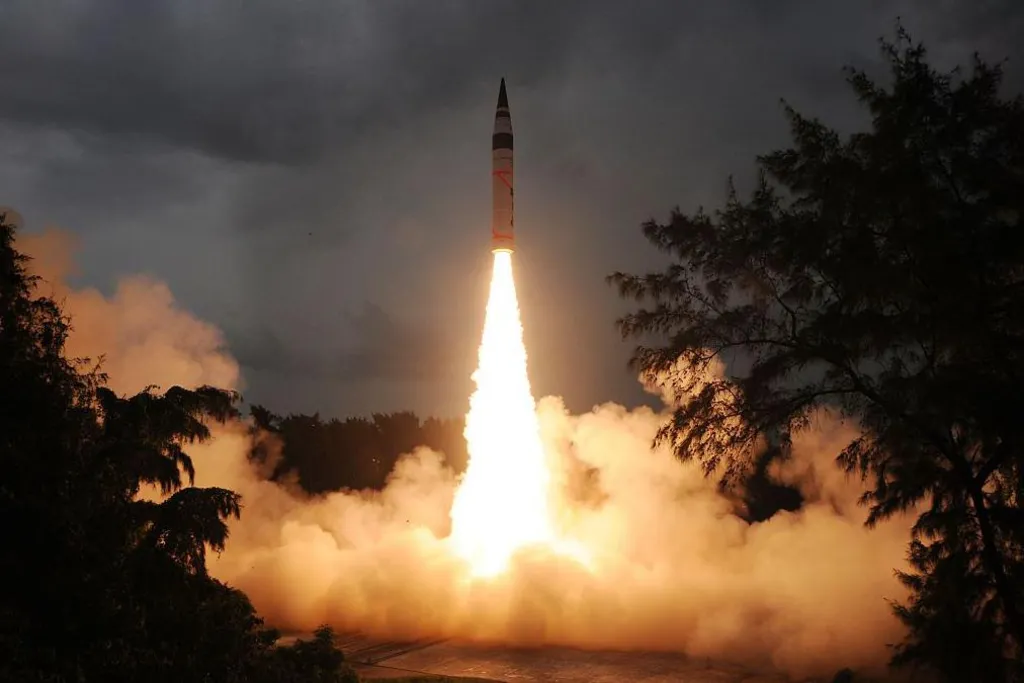
In the latest India-Pakistan stand-off, there were no ultimatums, no red buttons.
Yet the cycle of military retaliation, veiled signals and swift international mediation quietly evoked the region’s most dangerous shadow. The crisis didn’t spiral towards nuclear war, but it was a reminder of how quickly tensions here can summon that spectre.
Even scientists have modelled how easily things could unravel. A 2019 study by a global team of scientists opened with a nightmare scenario where a terroristattack on India’s parliament in 2025 triggers a nuclear exchange with Pakistan.
Six years later, a real-world stand-off – though contained by a US-brokered ceasefire on Saturday – stoked fears of a full-blown conflict. It also revived uneasy memories of how fragile stability in the region can be.
As the crisis escalated, Pakistan sent “dual signals” – retaliating militarily while announcing a National Command Authority (NCA) meeting, a calculated reminder of its nuclear capability. The NCA oversees control and potential use of the country’s nuclear arsenal. Whether this move was symbolic, strategic or a genuine alert, we may never know. It also came just as US Secretary of State Marco Rubio reportedly stepped in to defuse the spiral.
President Trump said the US didn’t just broker a ceasefire – it averted a “nuclear conflict”. On Monday, in an address to the nation, Indian Prime Minister Narendra Modi said: “[There] is no tolerance for nuclear blackmail; India will not be intimidated by nuclear threats.
“Any terrorist safe haven operating under this pretext will face precise and decisive strikes,” Modi added.
India and Pakistan each possess about 170 nuclear weapons, according to the think-tank Stockholm International Peace Research Institute (Sipri). As of January 2024, Sipri estimated there were 12,121 nuclear warheads worldwide. Of these, about 9,585 were held in military stockpiles, with 3,904 actively deployed – 60 more than the previous year. The US and Russia together account for more than 8,000 nuclear weapons.
The bulk of both India’s and Pakistan’s deployed arsenals lies in their land-based missile forces, though both are developing nuclear triads capable of delivering warheads by land, air and sea, according to Christopher Clary, a security affairs expert at the University at Albany in the US.
“India likely has a larger air leg (aircraft capable of delivering nuclear weapons) than Pakistan. While we know the least of Pakistan’s naval leg, it is reasonable to assess that India’s naval leg is more advanced and more capable than Pakistan’s sea-based nuclear force,” he told the BBC.
One reason, Mr Clary said, is that Pakistan has invested nowhere near the “time or money” that India has in building a nuclear-powered submarine, giving India a “clear qualitative” edge in naval nuclear capability.
Since testing nuclear weapons in 1998, Pakistan has never formally declared an official nuclear doctrine.
India, by contrast, adopted a no-first-use policy following its own 1998 tests. But this stance has shown signs of softening. In 2003, India reserved the right to use nuclear weapons in response to chemical or biological attacks – effectively allowing for first use under certain conditions.
Further ambiguity emerged in 2016, when then–defence minister Manohar Parrikar suggested India shouldn’t feel “bound” by the policy, raising questions about its long-term credibility. (Parrikar clarified that this was his own opinion.)
Leave a Reply